
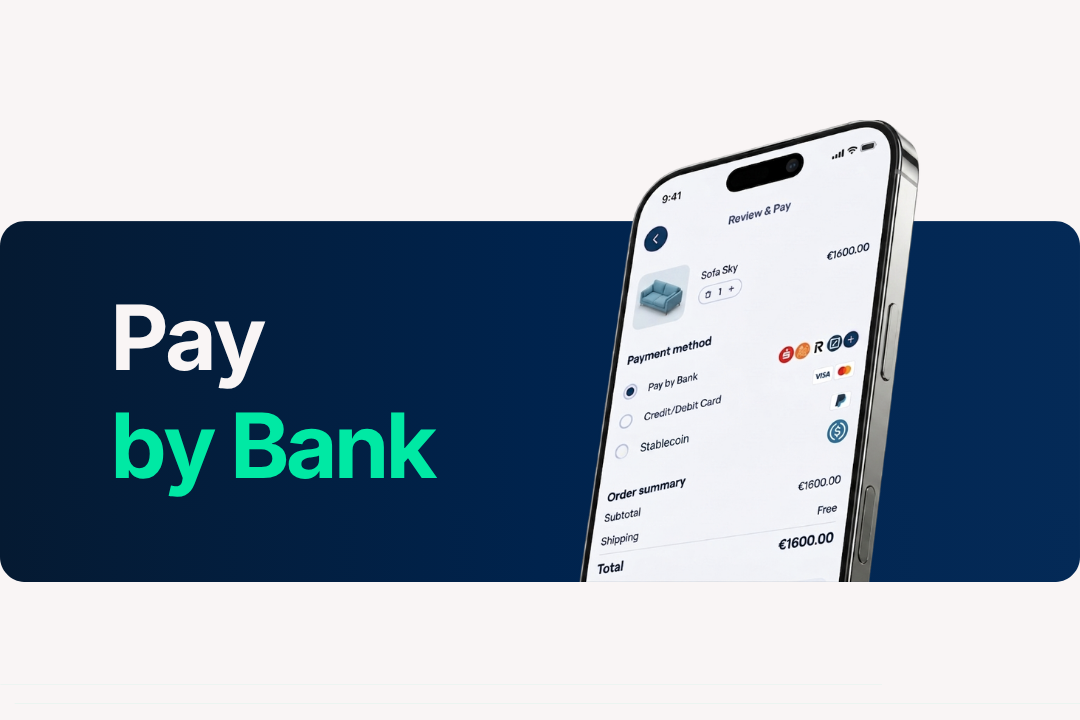
For most of the last decade, paying online meant cards. You entered 16 digits, an expiry date, a security code, and hoped the transaction went through. The experience has been almost universally accepted as normal - which does not mean it is good. Card payments carry fees of 1.5-3% per transaction, chargeback rates that drain merchant margins, settlement delays that tie up working capital, and fraud exposure that costs the global economy tens of billions of dollars a year.
Pay by Bank changes this architecture entirely. Instead of routing a payment through a card network, issuing bank, acquiring bank, and payment processor, Pay by Bank connects the payer's bank account directly to the payee's - instantly, securely, and at a fraction of the cost. It is the payment method that works better for both sides of the transaction simultaneously, which is why its adoption curve in Europe has gone from gradual to steep.
This guide covers the full picture: what Pay by Bank is and how it works technically, the specific benefits for consumers, the specific benefits for businesses, where it is being adopted fastest, and why multi-rail Pay by Bank - combining Open Banking A2A with cards and APMs in a single integration - is the payment infrastructure decision that delivers compounding returns.
- What is Pay by Bank and how does it work?
- The 5 reasons consumers prefer Pay by Bank
- The 6 reasons businesses are switching to Pay by Bank
- Pay by Bank across industries - where it delivers most
- Pay by Bank adoption - where the market stands in 2026
- Open Banking as Pay by Bank and the gateway to stablecoin payments
What Is Pay by Bank and How Does It Work?
Pay by Bank is a payment method that allows consumers and businesses to pay directly from their bank account to the recipient's bank account, using open banking APIs to initiate and authenticate the transfer in real time. It is also referred to as account-to-account (A2A) payment, bank transfer payment, or Pay by Bank transfer - all describing the same underlying mechanism: money moving directly between bank accounts, without a card network intermediary.
The technical foundation is open banking - the regulatory and API framework that allows authorised third-party providers to initiate payments from customer bank accounts with the customer's explicit, real-time consent. In the EU, this is enabled by PSD2 and being strengthened under PSD3. In the UK, the Open Banking framework has been live since 2018 and now processes over 31 million transactions per month.
How the Pay by Bank flow works, step by step
Customer selects Pay by Bank at checkout
Instead of entering card details, the customer chooses Pay by Bank from the payment options. This can be presented as a button, a QR code, or a seamless embedded experience in the platform UI.
Customer selects their bank
The customer selects their bank from a list. In well-optimised flows, their bank is pre-suggested based on browser or device signals, reducing friction to a single tap.
Authentication in the banking app
The customer is redirected to or opens their banking app, where they authenticate using biometrics (fingerprint or face recognition) or their banking PIN. Crucially, their account balance is visible at this step - a transparency feature no card payment offers.
Payment initiated and settled instantly
Once authenticated, the bank initiates the transfer directly. Settlement happens in seconds - not in hours, not on the next business day. The merchant receives real-time confirmation that funds are on their way, and the customer sees their balance update immediately.
No reusable credentials. No chargeback window.
Nothing sensitive leaves the customer's device or banking app. No card number, no expiry date, no CVV. The payment is authenticated at source, non-reversible by the card network, and creates a clean audit trail for both parties.
A card payment routes money through four or five intermediaries: merchant payment gateway, acquiring bank, card network (Visa/Mastercard), issuing bank, and back. Each intermediary takes a cut and adds a time delay. Pay by Bank removes all of them. Money moves in a straight line from payer to payee, authenticated by the bank that holds the funds, with settlement measured in seconds and cost measured in fractions of a percent.
The 5 Reasons Consumers Prefer Pay by Bank
Consumer adoption is the deciding factor for any payment method - no matter how compelling the business case, if users do not trust it, use it, and prefer it, it does not scale. Pay by Bank's 53% year-on-year growth in the UK is not driven by merchant mandate - it is driven by consumer preference. Here is why.
1. Instant refunds - money back in seconds, not days
Refunds are where card payments most visibly fail consumers. When a return is processed via card, the money has to travel back through the same chain of intermediaries it came through: merchant, acquirer, card network, issuing bank. This can take three to five working days - a delay that affects cash flow for the consumer and erodes trust in the merchant.
Pay by Bank eliminates this delay. Because the original payment was made directly from the consumer's bank account, the refund can travel directly back the same way, settling in seconds. For merchants using Yugo's payout infrastructure, refunds are processed via the same A2A rails as the original payment - regardless of how the purchase was originally made. The consumer does not wait. The funds are available immediately.
Why this matters at scale: research shows 80% of consumers say refund speed affects whether they shop with a brand again. Instant refunds are not a nice-to-have - they are a customer retention mechanism.
2. No card expiry - payments that keep working
Visa cards stored in payment vaults have an average lifespan of around 21 months. Mastercard cards average just 14 months before expiry, reissuance, or cancellation after a fraud incident. Every time a card expires or is replaced, every recurring payment, subscription, and stored payment detail associated with it fails - silently, until the customer notices a missed service or an unexpected late fee.
Pay by Bank is linked to a bank account, not a 16-digit card number. Bank accounts do not expire. They are not reissued after fraud incidents on the card network. A customer who sets up Pay by Bank for recurring payments does not need to update their payment details when their physical card is replaced - because the payment was never linked to the card in the first place. For subscription businesses, this alone is worth significant annual revenue that would otherwise be lost to involuntary churn.
3. Stronger security - every payment authenticated at the source
Online card fraud is at record levels. In the first half of 2025 alone, there were 1.94 million cases of unauthorised card fraud in the UK, with total losses of £299 million - the highest ever recorded for a six-month period. Remote purchase fraud cases rose 22% year-on-year.
The fundamental vulnerability is structural. When a consumer pays online with a card, they share credentials - card number, expiry, CVV - that are by design reusable. If those credentials are intercepted, leaked in a data breach, or harvested by a phishing attack, they can be used repeatedly until cancelled. The consumer may not discover the fraud for weeks.
Pay by Bank does not share reusable credentials. Every payment is authenticated in real time, in the consumer's own banking app, using biometrics or banking-grade PIN protection. Nothing leaves the device that can be replayed. No stored credentials can be stolen. There is no card-on-file to compromise. The authentication is the payment - and it happens once, at the source, for each individual transaction.
4. Balance visibility before spending
Card payments offer no visibility into the payer's balance at the point of transaction. Money leaves the account on a delay, sitting in "pending" states for hours or days, creating a gap between the perceived balance and the real one. For the millions of consumers managing tight household budgets - the FCA found 7.4 million UK consumers feel burdened by bills and credit commitments - this opacity is a genuine financial risk.
Pay by Bank shows the consumer their account balance during the authentication step, before they confirm the payment. If a purchase would cause an overdraft, the consumer can see this and make an informed decision before committing. Immediately after payment, their balance updates in real time. There is no pending state, no ambiguity, and no end-of-month surprises.
5. Payment resilience when cards go down
Card network outages are more common than most consumers realise. Visa and Mastercard together account for approximately 84% of UK retail payments, meaning a single outage in either network can effectively shut down commerce for millions of people. Research found that the average outage lasts 84 minutes - well beyond the 22-minute threshold after which most consumers will abandon a purchase entirely.
Pay by Bank runs on entirely separate infrastructure - open banking APIs that are independent of card scheme networks. When card systems experience downtime, Pay by Bank continues functioning. For consumers, this means a genuine fallback that does not require cash or a different card. For merchants, it means continuity of revenue during incidents that would otherwise create complete payment paralysis.
The 6 Reasons Businesses Are Switching to Pay by Bank
The consumer case for Pay by Bank is compelling. The business case is commercially decisive. For any company processing meaningful payment volumes, the cost, risk, and operational advantages of Pay by Bank over card-based payments represent a structural improvement in unit economics - not a marginal one.
Transaction Cost Reduction of Up to 60%
Card processing fees run 1.5-3% per transaction, including interchange, scheme fees, and processor markup. Pay by Bank processing costs are a fraction of that. For a business processing €5M per month, shifting even 50% of volume to Pay by Bank can generate significant monthly savings - often running into tens of thousands of euros.
Real-Time Settlement - Immediate Cash Flow
Card settlements arrive on T+1 or T+2 at best. Pay by Bank settles in seconds, 24 hours a day, 7 days a week, including weekends and bank holidays. Faster access to funds reduces the need for working capital financing and improves cash flow predictability across the entire business.
Near-Zero Chargebacks
Global chargeback volume is projected to reach 324 million transactions in 2028, costing businesses an average of $74 per dispute - not including the merchandise lost or the operational overhead of fighting disputes. Pay by Bank transactions are non-reversible by the card network. Refunds are handled by the merchant directly, eliminating the entire chargeback cycle.
Dramatically Reduced Fraud Exposure
Pay by Bank transactions require real-time biometric authentication by the account holder. There are no stored credentials to steal, no card details to intercept, and no network to exploit for unauthorised transactions. Fraud rates on open banking payments are structurally lower than on card payments.
Cleaner Operations and Reconciliation
A2A payments settle with clear, structured reference data directly from the banking system. Reconciliation is simpler, faster, and less error-prone than card reconciliation. For high-volume businesses, this reduces the back-office cost of payment operations meaningfully.
Higher Conversion in Key Markets
In markets where Pay by Bank dominates consumer preference - the Netherlands (80% monthly usage), Germany, and the UK - offering it at checkout is a conversion requirement, not an optional feature. Businesses without Pay by Bank in these markets are declining transactions from a majority of their local user base.
| Dimension | Card Payments | Pay by Bank |
|---|---|---|
| Transaction fee | 1.5-3% per transaction | Significantly lower than card rates |
| Settlement time | T+1 to T+2 business days | Seconds - 24/7/365 |
| Chargeback exposure | 0.5-1.5% of volume | Near-zero - non-reversible |
| Fraud mechanism | Reusable credentials - interceptable | Biometric at source - no reusable data |
| Weekend settlement | No - banking hours | Yes - always on |
| Balance visible to payer | No | Yes - at authentication |
| Expiry risk | Every 14-21 months | None - bank account does not expire |
| Network outage dependency | Visa/Mastercard - single point of failure | Independent open banking infrastructure |
Pay by Bank Across Industries - Where It Delivers Most
Pay by Bank delivers meaningful improvements for any business that processes payments - but the impact is sharpest in industries where card payment problems are most acute: high chargeback rates, high transaction values, global user bases with diverse payment preferences, and recurring payment models where card expiry causes systematic involuntary churn.
Travel Platforms and OTAs
Travel payments involve high transaction values, multi-currency flows, and a significant proportion of card-not-present transactions - the category with the highest fraud and chargeback exposure. Pay by Bank provides instant, authenticated settlement for high-value bookings without the chargeback risk that plagues travel merchants. In European markets where Pay by Bank is mainstream, OTAs that offer it as a checkout option see measurably higher conversion from the segment of users who actively prefer bank-direct payments.
E-commerce and Marketplaces
Friendly fraud - where a customer disputes a legitimate transaction - is rising sharply in e-commerce, with an 816% increase in online retail disputes reported between Q1 2023 and Q1 2024 in some markets. For marketplaces, the combination of Pay by Bank for buyer payments and A2A payouts for seller settlements removes the card network from both sides of the transaction - eliminating chargeback exposure on incoming payments while enabling instant, low-cost seller payouts across 150+ countries.
CFD and Forex Trading
Trading platforms lose up to 23% of potential depositors at the payment step, primarily due to card declines triggered by issuer risk flags on crypto-adjacent and trading-related transactions. Pay by Bank bypasses the issuing bank's decline logic entirely - the authentication happens in the user's banking app, and if the funds are available, the payment succeeds. For trading platforms, this is a direct conversion rate improvement on the most commercially important step in the user journey.
iGaming and Online Gaming
iGaming has the highest chargeback rate of any digital industry. Players dispute legitimate deposits at rates that push many operators into card network monitoring programs, triggering fines and account termination risk. Pay by Bank eliminates this entirely. Non-reversible A2A deposits remove the chargeback mechanism at the source, while faster withdrawals - a key driver of player loyalty - are enabled by real-time A2A payout settlement. For gaming operators processing high volumes, the combination of chargeback elimination and instant payouts is a transformative improvement in both economics and user experience.
Subscription and SaaS Businesses
Card lifecycle events-such as expiry, replacement, or fraud-driven reissuance-regularly lead to failed payments and lost revenue. As a result, a meaningful portion of any subscription base will experience payment disruption each year. Pay by Bank removes this entirely. Subscriptions linked directly to bank accounts continue uninterrupted, even when cards are replaced-reducing involuntary churn and improving retention.
Pay by Bank Adoption - Where the Market Stands in 2026
Pay by Bank adoption is not uniform across European markets - it is concentrated in the countries where open banking infrastructure matured earliest, consumer trust in digital banking is highest, and local payment culture already favoured direct bank transfers over cards.
The Netherlands market, where iDEAL has achieved over 80% monthly consumer usage, represents the mature endpoint of the Pay by Bank adoption curve. Germany is following with SOFORT and SEPA-based Pay by Bank adoption accelerating under PSD3 mandates. The UK recorded its highest ever monthly open banking payment volume - 31 million transactions - in early 2025, with the FCA confirming 53% year-on-year growth. Poland's BLIK is expanding beyond domestic use into regional markets.
Outside Europe, Pay by Bank equivalents are establishing dominant positions. India's UPI processes over 15 billion transactions per month. Brazil's PIX has become the country's most used payment method just four years after launch. These are not coincidences - they reflect a global pattern where direct bank payment infrastructure, once established and trusted, tends to displace card-based alternatives rapidly in its target market.
Open Banking at Yugo: Pay by Bank and the Gateway to Stablecoin Payments
Most providers treat Pay by Bank as a standalone checkout option - a slightly cheaper, slightly faster alternative to cards that sits alongside them at checkout. That is a narrow reading of what Open Banking actually enables.
At Yugo, Open Banking goes further, providing more options. On one hand, it serves as a direct payment rail for Pay by Bank (A2A) transactions. On the other hand, it is a fiat gateway that connects traditional bank accounts with blockchain payment infrastructure - enabling on-ramp via Open Banking, converting fiat directly to stablecoin. The two services can be used together or separately. They are two distinct options, accessible through a single API and managed from a single unified dashboard.
Function 1 - Open Banking as Pay by Bank
The first function is the one this article has covered in depth. When a consumer or business pays via Yugo's Open Banking integration, the payment initiates directly from their bank account, authenticates through their banking app, and settles in real time. No card network. No intermediary fees. No chargeback exposure. This is Pay by Bank as a primary pay-in method - and it works for both B2B and B2C payment flows, from e-commerce checkouts to marketplace deposits to trading platform top-ups.
Function 2 - Open Banking as the Fiat On-Ramp to Stablecoins
The second function is where Yugo's model goes further than most payment providers. Open Banking is also the mechanism through which fiat currency enters the stablecoin economy.
When a business or consumer needs to move value across borders, settle in stablecoins, or access blockchain payment rails, they need a fast, low-cost, compliant way to convert fiat into digital assets. Open Banking A2A is the most efficient on-ramp for this in EU markets - faster and cheaper than card-funded crypto purchases, and more reliable than manual bank wires. The flow looks like this:
Fiat enters via Open Banking A2A
The user initiates a Pay by Bank payment from their bank account. Settlement is near-instant, authenticated by biometrics, and costs a fraction of card-funded alternatives. This is the fiat on-ramp - the cleanest, most cost-efficient way to move money from a regulated bank account onto the next layer.
Fiat converts to stablecoin
The incoming fiat is converted to a stablecoin at a competitive rate. The user or business now holds digital value that settles across borders in seconds, operates 24/7, and carries none of the correspondent bank delays or FX markups of traditional cross-border wires.
Stablecoin moves across borders or chains
The stablecoin can be sent globally, used for B2B payments, held in a Yugo Wallet as a Service account, or deployed across blockchain payment flows. Cross-border stablecoin transfers that would take days and cost 3-5% via SWIFT settle in seconds at minimal cost.
Stablecoin off-ramps back to fiat
When the recipient needs fiat, the off-ramp converts stablecoins back to the target currency and settles directly to their bank account, card, wallet, or APM - whichever they prefer. The full cycle - fiat in via Open Banking, blockchain transit, fiat out via the recipient's chosen method - is completed through one integrated platform.
Open Banking is not just a cheaper card alternative. It is the bridge between the traditional banking system and the stablecoin payment economy. Businesses that integrate Open Banking A2A through Yugo are not only improving their Pay by Bank checkout experience - they are simultaneously gaining access to stablecoin cross-border payments, instant global settlements, and blockchain-native payment rails. One integration. Both dimensions of modern payments.
Stablecoin Payments: The Cross-Border Advantage
Stablecoins moved over $2 trillion across borders in 2024 - and the corridors growing fastest are precisely the ones where traditional banking is most expensive and slowest: Europe to Africa, Middle East to Asia, Latin America remittances. For businesses with international payment flows, stablecoin settlement is not a crypto experiment - it is a measurably superior payment infrastructure for cross-border transactions.
Yugo's stablecoin payment stack is built around leading regulated stablecoins - starting with USDC, the most widely adopted dollar-pegged stablecoin for business payments, with infrastructure designed to expand stablecoin coverage as the market and regulatory landscape matures. Combined with Open Banking, cards, APMs, and wallets for on- and off-ramps, plus virtual accounts and Wallet-as-a-Service for digital asset custody, Yugo delivers a complete end-to-end, one API solution for modern money movement.
Global Reach via Stablecoin Rails
Open Banking handles EU fiat flows with speed and low cost. Stablecoins extend that reach to 180+ countries where traditional banking is expensive, slow, or inaccessible - without needing local bank accounts or correspondent banking relationships in each market.
Treasury Efficiency
Businesses can hold stablecoin balances in Yugo's Wallet as a Service rather than pre-funding multiple bank accounts across jurisdictions. Stablecoin float eliminates the working capital overhead of multi-currency treasury management - funds are available instantly, wherever they are needed.
One API - Both Payment Worlds
Yugo's single API integration covers Pay by Bank pay-ins, stablecoin on-ramp and off-ramp, cross-border stablecoin transfers, and Wallet as a Service - all monitored through one unified dashboard. Businesses do not choose between traditional and blockchain payments. They access both through a single connection.
Pay by Bank Is Not a Trend - It Is a Better Payment Architecture
Pay by Bank is growing at 53% year-on-year in the UK, commands 80% monthly usage in the Netherlands, and is projected to account for a significant share of European e-commerce transactions before the end of 2026. But the most important insight is not the growth rate - it is the reason for it.
Pay by Bank grows because it is structurally superior to card payments for both consumers and businesses simultaneously. Consumers get faster refunds, no expiry risk, stronger security, and real-time balance visibility. Businesses get dramatically lower fees, instant settlement, near-zero chargebacks, reduced fraud exposure, and simpler operations. These are not marginal improvements - they are improvements across every dimension that matters.
The businesses that integrate Pay by Bank as part of a multi-rail payment stack today - alongside cards and APMs, through a single API with unified dashboard monitoring - are building cost and conversion advantages that compound over time. The businesses that delay are simply choosing to continue paying fees that are now optional, and accepting chargeback risk that is now avoidable.
Related Reading on the Yugo Blog
Add Pay by Bank to Your Payment Stack Today
Join businesses across Europe that are cutting payment costs,
eliminating chargeback exposure, and reaching more customers-
through a single, unified payment integration built for both B2B and B2C.


